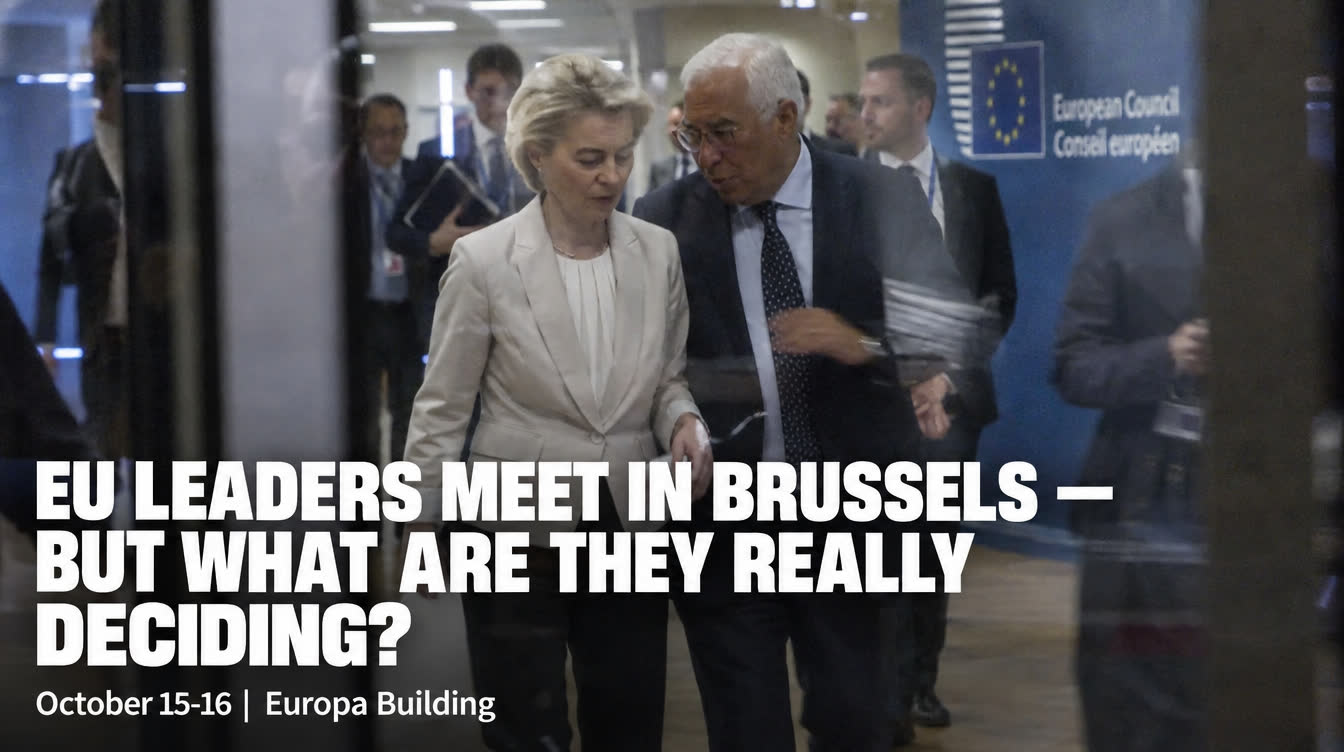
European leaders have set ambitious goals for defence, economic renewal and enlargement. The next challenge is turning summit language into decisions that can be financed and delivered.
When the heads of state and government of the European Union met in Brussels on 18 and 19 June 2026, they faced an agenda that reached far beyond routine coordination. Russia’s war against Ukraine remained the immediate security challenge, but leaders also had to consider Europe’s defence readiness, its next seven-year budget, industrial competitiveness, migration and enlargement.
The summit produced no single dramatic breakthrough. Its importance came from the way several separate debates were connected. Europe cannot support Ukraine without increasing military production. It cannot build a stronger defence industry without financing, energy and faster investment. It cannot enlarge the Union without reforming institutions and deciding how future budgets will be distributed.
Many of the hardest choices were left for the European Council’s October meeting. The June summit therefore established a direction and a deadline rather than a complete settlement.
Ukraine Remained the Central Priority
EU leaders reaffirmed support for Ukraine’s independence, sovereignty and territorial integrity. They also repeated that any peace settlement must respect international law, that borders cannot be changed by force and that decisions affecting Ukraine cannot be taken without Ukraine.
The conclusions called for faster production and delivery of air-defence systems, ammunition, drones and missiles. These priorities reflect the changing nature of the war. Protecting cities, power stations and other critical infrastructure requires a continuous supply of interceptors and equipment, not occasional political announcements.
The EU also welcomed the opening of the “fundamentals” cluster in Ukraine’s membership negotiations. This part of the accession process covers areas such as democratic institutions, the rule of law, public administration and economic criteria. Opening it does not guarantee a membership date, but it moves the process from symbolic support toward detailed legal and institutional work.
Leaders looked forward to the first disbursement from a €90 billion support loan for 2026 and 2027. The Commission later announced a €3.9 billion payment dedicated to drone procurement as part of the first tranche. The scale shows how financial support and defence production are becoming increasingly connected.
A Defence Deadline for 2030
The summit described Russia’s war as an existential challenge for the Union and called for Europe’s defence readiness to be decisively strengthened by 2030. That deadline gives political urgency to projects that can otherwise take many years.
Priority areas include air and missile defence, drones and counter-drone systems, early warning, deep precision strike capabilities, space assets and military mobility. Leaders also called for stronger protection of Europe’s land, air and maritime borders after repeated violations and hybrid attacks.
The conclusions emphasised that a stronger European defence role should complement NATO. That formulation is important for member states that want greater European capacity without weakening the transatlantic alliance. It also recognises that the United States may not always provide the same level of political attention or industrial support.
Spending more is only part of the task. European countries often purchase different systems, maintain separate requirements and place small national orders. The summit called for greater aggregation of demand, common procurement and better access to cross-border defence supply chains, including for smaller companies.
Europe must also expand industrial capacity. A new procurement programme cannot deliver quickly if factories lack skilled labour, components or long-term contracts. Governments will need to give manufacturers predictable orders while preventing emergency spending from becoming wasteful.
The security debate has continued since June. At the first European Arctic Summit on 14 September, twelve EU countries called for a more strategic European role in the Arctic. Climate change, shipping routes, critical minerals and Russia’s military presence are turning the region into another test of European preparedness.
The Budget Behind the Promises
Every major priority leads to the same argument: who will pay?
The European Council discussed the EU’s next Multiannual Financial Framework, covering 2028–2034. Leaders asked the Irish presidency of the Council to develop the negotiating framework by October, with the aim of reaching an agreement before the end of 2026.
That timetable is intended to give the European Parliament and member states enough time to approve the legislation required before the new budget begins in January 2028. A delay could interrupt funding for farmers, regions, research, infrastructure and external programmes.
The dispute is not only about the size of the budget. Defence, Ukraine, industrial policy and enlargement compete with established priorities such as agriculture and regional development. Net contributors want spending discipline, while other governments argue that Europe cannot demand strategic independence without providing common resources.
Leaders will also have to decide whether the Union should rely mainly on national contributions, create additional EU revenue sources or use more common borrowing. Each option has political costs. National contributions place pressure on domestic budgets, new levies face resistance and joint debt remains controversial in fiscally conservative countries.
Competitiveness Becomes a Security Issue
The June conclusions linked competitiveness with strategic autonomy and economic security. Leaders called for faster progress on the single market, simpler administrative procedures, shorter permitting times, affordable energy and stronger investment.
This agenda responds to a clear concern: Europe has excellent research, skilled workers and a large consumer market, but companies can struggle to grow across national borders. Energy-intensive industries face high costs, while technology companies often depend on foreign capital, chips and cloud infrastructure.
The “One Europe, One Market” agenda is intended to reduce fragmentation. A genuinely integrated market could give European businesses the scale to compete with American and Chinese firms. Yet simplification will become politically difficult if it is interpreted as weakening consumer, labour or environmental protection.
Carbon pricing illustrates the balance. Leaders asked the Commission to review the Emissions Trading System and address concerns from industrial sectors while preserving its role in the energy transition. Companies want a predictable path that supports investment rather than sudden cost shocks.
Migration and Enlargement Move to October
The summit reviewed progress on migration but reserved a strategic discussion for October. That debate is likely to focus on partnerships with countries outside the EU, border management, returns and the implementation of the migration pact.
Enlargement and internal reform were also moved to the October agenda. Ukraine, Moldova and the Western Balkans have renewed the political momentum for expansion, but a larger Union may require changes to voting, funding and decision-making.
The central question is whether the EU can welcome new members without making its institutions slower and its budget disputes more severe. Existing members will protect their influence and financial interests, while candidate countries expect accession to provide full rights rather than permanent second-tier status.
What the Summit Really Revealed
The June meeting showed that Europe increasingly treats defence, trade, energy and technology as parts of one strategic challenge. It is no longer enough to regulate a market or announce a security goal in isolation. The Union must align finance, infrastructure and industrial production.
The October summit will be a test of delivery. Leaders are expected to return to the budget, competitiveness, defence, migration and enlargement. If they make measurable decisions, June may be remembered as the point when Europe organised its priorities around a 2030 security deadline.
If the difficult questions are postponed again, the gap between European ambition and capacity will remain. Summits can establish direction, but credibility depends on contracts signed, equipment produced, energy connections built and funds delivered.